
We break down the specific financial and operational differences between manual underwriting and intelligent automation to help you recover lost revenue.
The gap between legacy financial institutions and modern payment technology companies is no longer a gap. It is a canyon, defined by a single, critical function: merchant onboarding. Your ability to approve and activate merchants quickly and efficiently is the primary driver of your portfolio’s growth.
Yet, many Independent Sales Organizations (ISOs) and acquiring banks are still held back by manual, outdated underwriting processes. This is not just an operational slowdown. It is a quantifiable tax on your growth that directly impacts your profit and loss.
Table of Contents
• The Financial Reality of Legacy Underwriting in 2026
• How Automated Underwriting Transforms the Merchant Lifecycle
• Comparing Operational Outcomes and Efficiency Benchmarks
• Implementing Intelligent Automation for ISOs and PayFacs
The Financial Reality of Legacy Underwriting in 2026
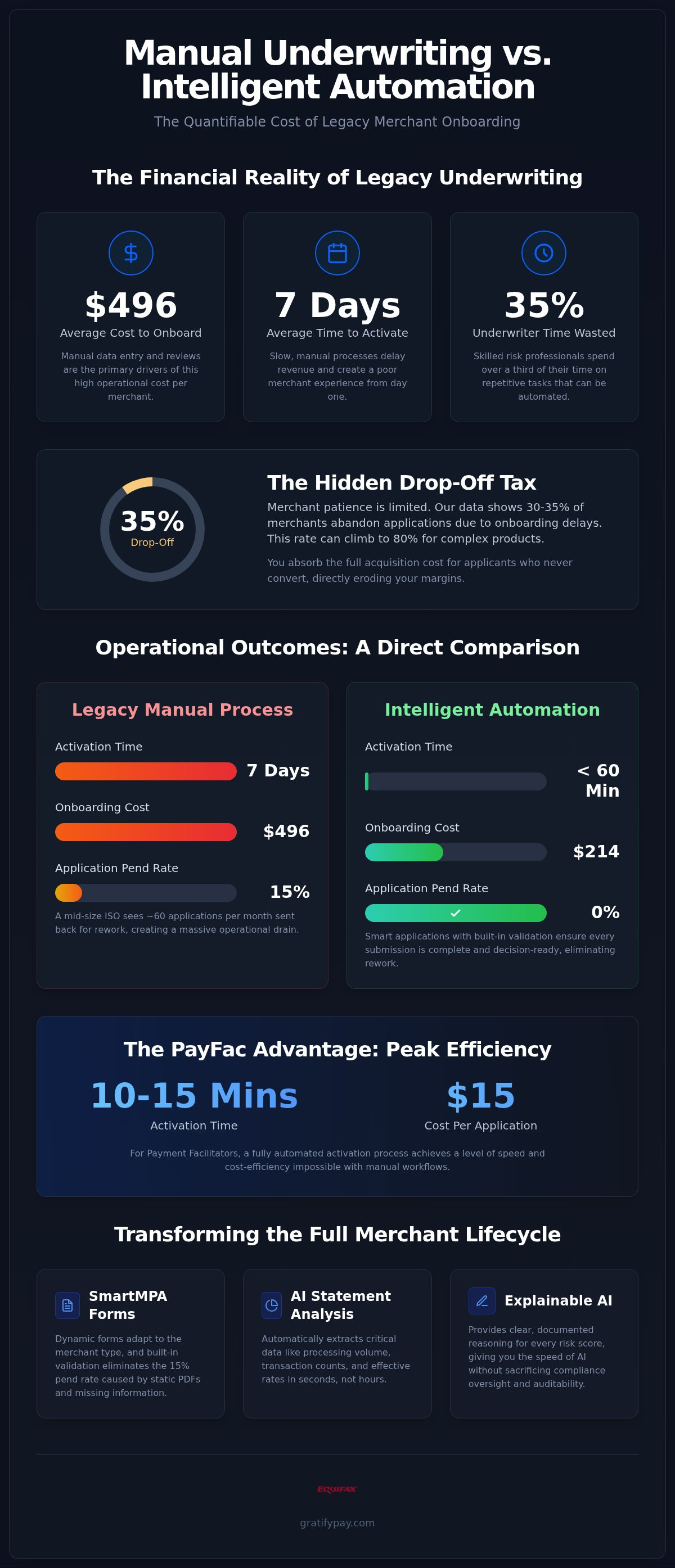
Manual underwriting is a slow and expensive process that limits your ability to scale. For traditional banks, the standard merchant onboarding process often takes up to seven days to complete. This delay introduces significant friction and risk into your acquisition funnel.
Based on our 2026 industry report, the average cost for a traditional bank to onboard a single merchant is $496. We have seen underwriters at large acquirers spend 60 to 70 percent of their day on low-value data entry, manually reviewing documents and keying in information that an automated system could process in seconds.
The True Cost of Manual Reviews
Legacy systems require humans to manually parse bank statements, verify business details, and cross-reference compliance watchlists. This intensive manual work is the primary reason legacy onboarding costs nearly $500 per application. We find that 30 to 35 percent of an underwriter's time is wasted on repetitive tasks that could be fully automated.
This is not an efficient use of skilled risk professionals. Their expertise should be reserved for complex, high-risk cases, not for routine data verification that software can handle more quickly and accurately.
The Hidden Drop-Off Tax
Merchant patience has a limit. When onboarding delays exceed their tolerance, our data shows 30 to 35 percent of merchants abandon the application. For more complex banking and fintech applications, this abandonment rate can climb as high as 68 to 80 percent.
This drop-off tax means you are losing significant revenue before a merchant even processes their first dollar. You absorb the full cost of acquisition and underwriting for an applicant who never converts, directly eroding your margins.
How Automated Underwriting Transforms the Merchant Lifecycle
Automation replaces fragmented tools and manual workflows with a single, intelligent platform for the full merchant lifecycle. Modern platforms use AI Statement Analysis to extract critical data like processing volume, transaction counts, and effective rates in seconds. Our Credit Underwriting engine then generates clear approval recommendations complete with documented reasoning.
This transition allows your team to shift its focus from routine data entry to managing high-risk exceptions. You empower your underwriters to make faster, more informed decisions, turning a cost center into a competitive advantage.
Smart Merchant Applications and Adaptive Logic
We use SmartMPA to create dynamic forms that adapt to the merchant type and risk profile in real time. Static PDF applications are a primary source of friction, leading to an average 15 percent pend rate because they ask for irrelevant or confusing information.
SmartMPA includes built-in validation to ensure applications are complete and accurate before they ever reach an underwriter. This simple change eliminates the back-and-forth communication that stalls applications and frustrates merchants.
Explainable AI vs Black Box Decisions
Many risk managers fear AI because they do not understand how it reaches a decision. This is a valid concern, especially in a highly regulated industry. Our platform is different because it uses explainable AI that provides clear, documented reasoning for every risk score and recommendation.
This transparency ensures your compliance team maintains full oversight of the merchant underwriting automation process. You get the speed and efficiency of AI without sacrificing the control and auditability required to manage risk effectively.
Comparing Operational Outcomes and Efficiency Benchmarks
The operational gap between legacy institutions and modern PayTechs is widening every year. While a traditional bank takes seven days to activate a merchant, a modern PayTech can do it in under 60 minutes. The cost difference is equally stark: PayTechs average $214 per merchant compared to the $496 bank average.
For Payment Facilitators (PayFacs), the benefits are even more dramatic. A fully automated PayFac activation can drop to as low as 10 to 15 minutes at a cost of just $15 per application. This level of efficiency is impossible to achieve with manual processes.
Speed to Revenue Benchmarks
Every day a merchant waits for approval is a day of lost processing volume for your portfolio. Slow onboarding directly delays your revenue. Modern merchant boarding automation allows you to start generating revenue on day one, not day seven.
By activating merchants in minutes, you not only improve the merchant experience but also accelerate your own cash flow. We recommend reading our automated underwriting software 2026 definitive guide for a deeper analysis of these benchmarks.
Eliminating the Rework Burden
In a mid-size ISO handling 400 submissions a month, a 15 percent pend rate means roughly 60 applications are sent back due to errors or missing information. This rework burden is a massive drain on operational resources, forcing your team to chase down documents instead of approving new business.
Automation prevents these pends by identifying missing documents and data instantly. Integrated checks for KYC KYB merchant onboarding information ensure every application is decision-ready upon submission, eliminating the rework cycle entirely.
Implementing Intelligent Automation for ISOs and PayFacs
Transitioning from legacy systems to intelligent automation does not require a total system overhaul. We use a modular approach that allows you to adopt only the stages your business needs, targeting the biggest bottlenecks first. Our API-driven architecture enables you to move from your first conversation to a live environment in a single sprint.
We have seen organizations use this model to 10x their onboarding capacity without adding a single new staff member. The goal is to augment your existing team, not replace it.
The 90-Day Transformation Plan
We typically follow a structured 90-day plan to ensure a smooth transition. The first 30 days focus on an audit to baseline your current costs, timelines, and manual touchpoints. This gives us a clear picture of where the biggest opportunities for improvement lie.
Days 31 to 60 involve implementing quick wins, like deploying SmartMPA to immediately reduce pend rates. In the final 30 days, we focus on rolling out full intelligent automation for credit and risk assessments to complete the transformation.
Scaling Without Headcount
Automation allows your current team to handle a much higher volume of applications with greater accuracy. By reducing manual reviews by 40 percent, your underwriters can stop focusing on low-risk, cookie-cutter applications and dedicate their expertise to complex enterprise deals that drive real growth.
This efficiency is the only sustainable way to compete in a market where 69 percent of merchants now demand fast, low-friction onboarding. It allows you to scale your portfolio without scaling your payroll.
FAQs about Legacy Underwriting vs. Automation
How much does legacy merchant underwriting cost on average?
The average cost for a traditional bank to onboard a single merchant is $496. This is primarily driven by the manual labor required for document review, data entry, and compliance checks.
What is the typical activation time for a traditional bank vs a PayTech?
A traditional bank often takes up to seven days to approve and activate a new merchant account. In contrast, a modern PayTech using automation can activate the same merchant in under 60 minutes.
Why do 30-35 percent of merchants abandon the onboarding process?
Merchants abandon applications when manual delays exceed their tolerance for waiting. Long wait times create uncertainty and friction, prompting them to seek out a faster, more responsive processor.
What is the difference between black-box AI and explainable AI in underwriting?
Black-box AI provides a decision without showing its work, making it difficult to audit or trust. Explainable AI, which we use, documents the specific reasons and data points behind every recommendation, ensuring full transparency for risk and compliance teams.
How does SmartMPA reduce the number of pended merchant applications?
SmartMPA uses dynamic logic and built-in data validation to ensure applications are complete and accurate before submission. This prevents common errors and missing information that cause static forms to be pended, which can be as high as 15 percent of all applications.
Automate Your Underwriting Workflow
Stop paying the price for slow, manual onboarding. Automation converts a costly liability into a profit center that accelerates revenue and lets you scale your portfolio without limits.
Book a demo to see how we automate your underwriting workflow.
Calculate your onboarding costs
ISOs processing 1,000 merchants/year spend $250K on manual onboarding. See your numbers.
Get Your Cost Analysis