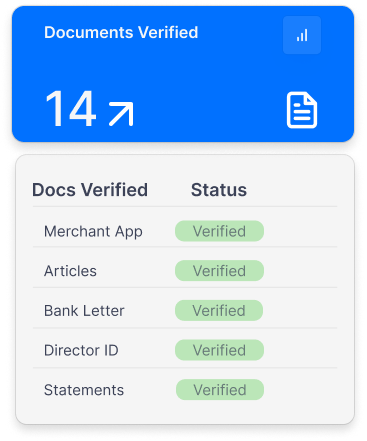
Is your onboarding process a competitive advantage or a silent revenue killer? In 2026, relying on manual reviews isn't just slow; it's a structural liability that modern automated underwriting software has rendered obsolete. You've likely seen high-value merchants abandon their applications because your KYC and KYB checks are stuck in a human-led bottleneck. Inconsistent risk assessments and manual data entry don't just delay growth; they invite unnecessary risk into your portfolio.
This guide shows you how to eliminate these friction points. You'll learn to reduce onboarding time by over 80% and achieve 95% straight-through processing by replacing legacy systems with real-time intelligence. We'll also break down the critical 2026 regulatory shifts, including the EU AI Act compliance requirements and new CFPB guidance, to ensure your automation is both fast and compliant. It's time to scale your portfolio without adding a single seat to your risk team. We're moving beyond gatekeeping to a future of dynamic, data-driven acquisition.
Key Takeaways
• Understand why the industry is shifting from static credit scoring to dynamic risk assessments powered by real-time KYC, KYB, and cash flow data.
• Discover how modern automated underwriting software replaces manual bottlenecks with intelligent data capture and instant document parsing.
• Learn to calculate the "Onboarding Tax" and see how reducing merchant friction can slash abandonment rates while increasing portfolio stickiness.
• Explore how to configure decision engines that balance high-speed approvals with the strict 2026 regulatory requirements of the EU AI Act and CFPB.
• Achieve 95% straight-through processing by integrating smart forms and automated verification into a single, high-conversion onboarding workflow.
What is Automated Underwriting Software?
Automated underwriting software is the end of the "waiting game" in financial services. It is a high-performance engine that uses artificial intelligence and pre-set logic to ingest data, verify identities, and calculate risk in seconds. While the legacy Automated Underwriting System (AUS) frameworks were originally built for predictable mortgage models, modern merchant underwriting requires a more aggressive, dynamic approach. It is the difference between a static snapshot and a live stream of risk intelligence.
We've moved beyond the era of static credit scores. In 2026, the industry has pivoted to "Agentic AI." This represents a massive leap from simple rule-based OCR. Old systems could read a document; Agentic AI reasons through it. It cross-references KYC and KYB data against real-time cash flow and global watchlists to spot fraud patterns that humans might miss. For ISOs and PayFacs, this software is the only way to achieve the 95% straight-through processing benchmarks required to stay competitive.
Merchant underwriting is fundamentally different from consumer lending. Consumer automation is a straight line. Merchant underwriting is a complex web of business entities, beneficial owners, and processing histories. You aren't just checking a person; you're validating an entire commercial ecosystem. Modern engines handle this complexity without slowing down the user experience.
The Core Components of an Underwriting Engine
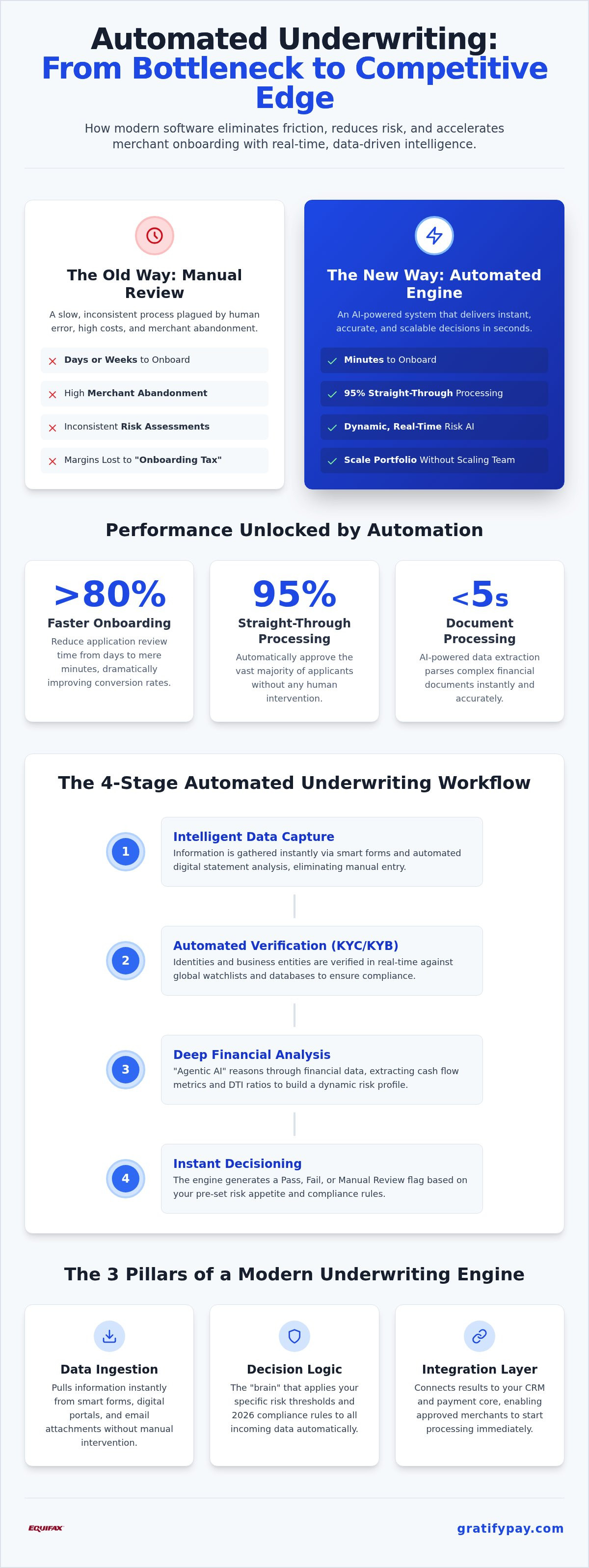
A modern engine relies on three pillars. First, data ingestion pulls information from smart forms, digital portals, and email attachments instantly. Second, the decision logic acts as the "brain." It applies your specific risk thresholds and compliance rules to the incoming data. Finally, the integration layer connects these results to your CRM and payment processing core. This ensures that once a merchant is approved, they can start processing immediately. There's no manual handoff and no room for data entry errors.
The Evolution from Legacy to Digital Platforms
The PDF is officially dead. Manual document reading is a "tax" on your team that kills your margins. Legacy systems relied on batch processing, where applications sat in a queue for days. Digital platforms have replaced this with real-time approvals. Cloud-native architectures now allow ISOs to scale nationally without hiring a small army of risk analysts. You can now approve a merchant in minutes, not days. This shift from "review and wait" to "verify and approve" is why legacy-burdened institutions are losing market share to tech-forward partners.
How Automated Underwriting Engines Work
Modern automated underwriting software operates as a high-speed assembly line for risk intelligence. It doesn't just wait for a file; it proactively hunts for information across digital ecosystems. The process moves through four distinct phases that transform a raw application into a finalized decision in seconds. First, intelligent data capture gathers information through smart forms and digital statement analysis. Second, the system triggers automated KYC and KYB verification against global watchlists. Third, the engine performs deep financial analysis, extracting cash flow metrics and debt-to-income (DTI) ratios directly from bank statements. Finally, the decisioning layer generates a pass, fail, or manual review flag based on your specific risk appetite.
This workflow eliminates the "dead time" inherent in manual reviews. While a human underwriter might take hours to spread a single financial statement, an automated engine completes the task before the merchant even leaves the application page. This speed is critical for maintaining high conversion rates in a market where merchants expect instant gratification.
Digital Statement Analysis and Data Extraction
The role of Large Language Models (LLMs) has revolutionized how systems handle complex financial documents. Unlike old OCR technology that simply "saw" text, modern engines understand the context of a ledger. They can distinguish between a loan deposit and earned revenue without human intervention. This eliminates manual data entry entirely; the software "spreads" the data into your risk model automatically. Statement analysis is the bridge between raw data and credit decisions. By leveraging automated underwriting software with high parsing accuracy, institutions can process documents in under five seconds while maintaining a granular view of merchant health. If you want to see this speed in action, exploring modern statement analysis tools is the logical next step.
KYC & KYB: The Compliance Backbone
Compliance is no longer a separate, manual hurdle. It's the backbone of the automated workflow. Automating business identity verification (KYB) allows you to peel back the layers of corporate structures to identify beneficial owners instantly. The system performs real-time screening against OFAC, AML, and PEP watchlists without human intervention. This doesn't just prevent fraud; it ensures absolute consistency across your entire portfolio. Smart Forms further reduce friction by using conditional logic. They only ask for missing information or additional documentation if the initial automated checks trigger a specific risk threshold. This surgical approach to data collection keeps the merchant engaged while keeping your compliance standards airtight.
Evaluating ROI: Speed vs. Security
Every hour a merchant spends waiting for an approval is an hour they spend reconsidering their choice. This is the "Onboarding Tax." It is the measurable cost of friction that leads to merchant abandonment and lost lifetime value. When you rely on manual reviews, you aren't just paying for an underwriter's time; you're paying for the high-value accounts that walked away because your process was too slow. Automated underwriting software flips this dynamic. It transforms risk assessment from a cost center into a customer acquisition engine. By delivering instant results, you secure merchant "stickiness" before they have a chance to look elsewhere.
The true power of automation lies in its ability to scale without a corresponding increase in headcount. Traditional risk teams are often the primary bottleneck during periods of rapid growth. Adding more staff is a slow and expensive solution to a structural problem. An AI-driven engine allows you to manage 10x your current application volume with the same team. These systems don't just work faster; they work with a level of precision that humans cannot replicate. While a reviewer might miss a subtle pattern in a bank statement, an automated engine cross-references thousands of data points simultaneously to spot fraud with surgical accuracy.
Manual Underwriting vs. Automation
The contrast between legacy methods and modern automation is stark. Manual reviews typically require a 3-5 day window for completion. In that time, the merchant's interest cools. Automated underwriting software reduces this timeframe to under 5 minutes for most applications. This speed eliminates the "human element" of error, specifically in data transcription and statement spreading. Operational savings are realized immediately as your risk staff shifts from tedious data entry to high-level portfolio strategy. Instead of reading PDFs, they focus on optimizing risk thresholds and identifying new market opportunities.
The Strategic Advantage for ISOs and PayFacs
For ISOs and PayFacs, speed is the ultimate competitive edge. Winning the merchant's business often comes down to who can offer the fastest time-to-process. Beyond the initial approval, automated platforms provide ongoing portfolio health monitoring. They use real-time analytics to track risk post-onboarding, ensuring that your portfolio remains healthy as it grows. This technology also enables seamless national reach. You can standardize your underwriting rules across all US states, ensuring consistent compliance and risk management regardless of where the merchant is located. This structural consistency is what allows ambitious organizations to dominate the market.
Key Features of Modern Underwriting Software
Modern automated underwriting software has evolved into a modular intelligence platform. It is no longer a black box that spits out a "yes" or "no" decision. It is a customizable engine designed to adapt to your specific risk appetite in real time. The most critical feature is the configurable decision engine. This allows your risk team to tweak rules and thresholds on the fly without writing a single line of code. If you detect a shift in market risk or a new fraud trend, you adjust your parameters in minutes. You don't wait for a developer. You don't wait for a software update. You lead the market because you can pivot faster than your competition.
Integrated KYC and KYB are the standard for 2026. These aren't just add-ons; they are native components of the onboarding workflow. By combining these with digital statement analysis, the software builds a 360-degree view of merchant health instantly. White-labeling ties this experience together. It ensures that your brand remains front and center during the entire application process. This builds trust with high-volume merchants who value professional, cohesive experiences from the first click to the final approval.
Smart Forms and UX Optimization
Conversion happens in the details. Smart forms use conditional logic to hide irrelevant fields, ensuring the merchant only sees questions that apply to their specific industry or business type. This surgical approach to data gathering prevents form fatigue and keeps the applicant focused. Mobile-first design is also mandatory. Merchants are often on the move; they need to upload documents and sign agreements from their phones with minimal friction. Including a progress-saving feature ensures that even if an application is interrupted, the merchant can return and finish it without starting over. This simple addition significantly reduces abandonment rates for complex, multi-stakeholder applications.
API-First Architecture
Your stack is only as strong as its connections. An API-first architecture ensures that your automated underwriting software plays well with your existing CRM and payment processing cores. It bridges the gap between legacy systems and modern innovation. This "plug-and-play" capability is essential for future-proofing your business. As new alternative data sources or regulatory requirements emerge, you can integrate them into your workflow without rebuilding the entire system. You stay agile, compliant, and ready for whatever the financial landscape throws at you next.
Don't let legacy bottlenecks hold your portfolio back. Explore Gratify’s underwriting automation and start scaling your merchant acquisition today.
Scaling Your Portfolio with Gratify’s Onboarding Platform
Gratify is the disruptive evolution for ISOs and PayFacs tired of the manual status quo. You don't need a larger team; you need a smarter system. Our automated underwriting software is built to handle the heavy lifting of merchant acquisition by removing every manual touchpoint from the onboarding process. We replace the frustration of document queues with the empowerment of high-speed capability. This isn't just a marginal improvement; it's a complete reimagining of how financial institutions interact with new clients. By the time a merchant finishes their application, your risk assessment is already complete.
The power of integrated statement analysis cannot be overstated. It provides an instant credit risk assessment that goes deeper than a simple credit score. This allows your risk team to focus on growth rather than paperwork. They become a high-performance unit capable of managing complex portfolios with total precision. Gratify turns your underwriting department into a game-changing ally for your sales team. You stop being the bottleneck and start being the accelerator that allows your organization to capture market share before the competition even opens the file.
End-to-End Automation for Payment Providers
We move applications from smart form submission to merchant approval in a single, frictionless workflow. This isn't just about speed; it's about structural transformation. Gratify standardizes compliance across your entire national portfolio, ensuring that every approval meets your rigorous risk standards. You reduce operational overhead while maintaining total control over your risk appetite. This structural consistency is your greatest asset. It allows you to enter new verticals and territories without worrying about inconsistent risk assessments across manual teams. You achieve a high-performance state where growth is limited only by your ambition, not your infrastructure.
The Future of Merchant Acquisition
The industry is moving toward "Instant Merchant Approval" as the baseline expectation. Legacy-burdened institutions that stick to three-day review cycles are already falling behind. Merchants gravitate toward the path of least resistance; if you don't approve them in minutes, they'll find someone who will. Gratify helps you catch up to and surpass the future of fintech by providing a platform that is already living there. You gain a reliable partner that values your time and your success above all else. It's time to leave the manual bottlenecks in the past and embrace a future of frictionless acquisition.
Schedule a demo with Gratify to see automated underwriting in action.
Own the Future of Merchant Acquisition
The era of manual data entry and multi-day waiting periods is over. In 2026, high-performance ISOs and PayFacs recognize that legacy bottlenecks aren't just an inconvenience; they're a structural threat to market share. By implementing automated underwriting software, you replace systemic friction with a streamlined intelligence engine that works at the speed of modern commerce. You've seen how integrated KYC, KYB, and digital statement analysis transform your risk team from a cost center into a strategic acquisition partner.
Gratify was built specifically to solve the unique challenges of merchant providers. We empower you to onboard merchants in minutes rather than days while maintaining the most rigorous compliance standards. It's time to stop reacting to the market and start leading it. You can scale your portfolio with total confidence and zero additional headcount. The technology exists to make your onboarding process your greatest competitive advantage.
Automate your merchant underwriting with Gratify and leave the manual struggle behind. Your growth shouldn't have to wait for a signature.
Frequently Asked Questions
What is automated underwriting software?
Automated underwriting software is a high-performance digital engine that evaluates risk and approves applications using AI and pre-set rules. It replaces manual, paper-based reviews with real-time data processing. For ISOs and PayFacs, this means instantly verifying merchant identities and financial health. The software acts as a dynamic intelligence layer that adapts to your risk appetite; ensuring every decision is consistent and data-driven across your entire national portfolio.
How much time can automated underwriting save during merchant onboarding?
Automation accelerates merchant approval times from several days down to just a few minutes. By eliminating manual data entry and document queues, you remove the primary bottleneck in your growth strategy. This speed allows your team to achieve 95% straight-through processing. Merchants can move from submitting a smart form to processing payments in a single session, which drastically improves your operational efficiency and allows your risk staff to focus on high-level strategy.
Is automated underwriting as secure as manual review?
It is often more secure than manual review because it eliminates human error and transcription mistakes. Modern automated underwriting software cross-references thousands of data points against global watchlists simultaneously. While a human might miss subtle fraud indicators in a bank statement, an AI-driven engine identifies patterns with surgical precision. This ensures that your risk standards are applied rigorously and consistently to every application; regardless of volume or complexity.
What is the difference between KYC and KYB in underwriting?
Know Your Customer (KYC) focuses on verifying the identity of individual applicants or beneficial owners. Know Your Business (KYB) verifies the legal entity itself; including its corporate structure and legitimacy. In merchant underwriting, both are essential. Automated systems perform these checks in parallel; peeling back layers of corporate ownership to ensure you aren't just approving a person, but validating an entire commercial ecosystem against AML and OFAC standards.
Can automated underwriting software integrate with my existing CRM?
Yes; modern automated underwriting software utilizes an API-first architecture designed for seamless integration with your existing CRM and payment processing core. This connectivity bridges the gap between legacy systems and modern automation. It ensures that once a merchant is approved, their data flows instantly into your management systems without manual intervention. This future-proofs your tech stack and allows you to ingest new data sources as they emerge in the fintech landscape.
Does automated underwriting help with AML compliance?
Automation is a critical tool for Anti-Money Laundering (AML) compliance. The software performs real-time screening against OFAC, PEP, and global sanctions lists without requiring human intervention. By standardizing these checks, you ensure that every merchant in your portfolio meets the same rigorous regulatory requirements. This consistency is vital for maintaining your standing with partner banks and avoiding the heavy penalties associated with non-compliance in a rapidly evolving regulatory environment.
What is digital statement analysis in the context of risk assessment?
Digital statement analysis is the automated extraction of financial health metrics from bank statements and tax documents. Instead of an underwriter manually "spreading" data into a spreadsheet, the software parses income, assets, and cash flow in under five seconds. It identifies fraud signals and calculates debt-to-income ratios instantly. This technology serves as the bridge between raw financial data and a finalized credit decision; providing a granular view of merchant risk.
How does automation reduce merchant abandonment rates?
Automation reduces abandonment by eliminating the "Onboarding Tax" of long wait times and repetitive data requests. Smart forms use conditional logic to only ask for necessary information; which keeps merchants engaged. When approvals happen in minutes instead of days, merchants don't have time to reconsider or look for a faster competitor. Providing a frictionless, mobile-first application experience builds immediate trust and secures merchant "stickiness" before they leave your portal.
Calculate your onboarding costs
ISOs processing 1,000 merchants/year spend $250K on manual onboarding. See your numbers.
Get Your Cost Analysis