Independent Sales Organizations (ISOs) that rely on manual underwriting are facing a significant growth ceiling. Slow, labor-intensive processes not only increase operational costs but also create poor merchant experiences, leading to application abandonment. In a market where speed is a competitive advantage, the delay between application and approval is a critical vulnerability.
In 2026, underwriting is no longer a back-office hurdle. It is a front-end differentiator that determines an ISO's capacity to scale. AI-driven underwriting platforms and automated Know Your Customer (KYC) and Know Your Business (KYB) checks are allowing forward-thinking ISOs to reduce onboarding times from days to minutes. This guide explains how to implement this shift, reduce operational drag, and turn your underwriting process into a growth engine.
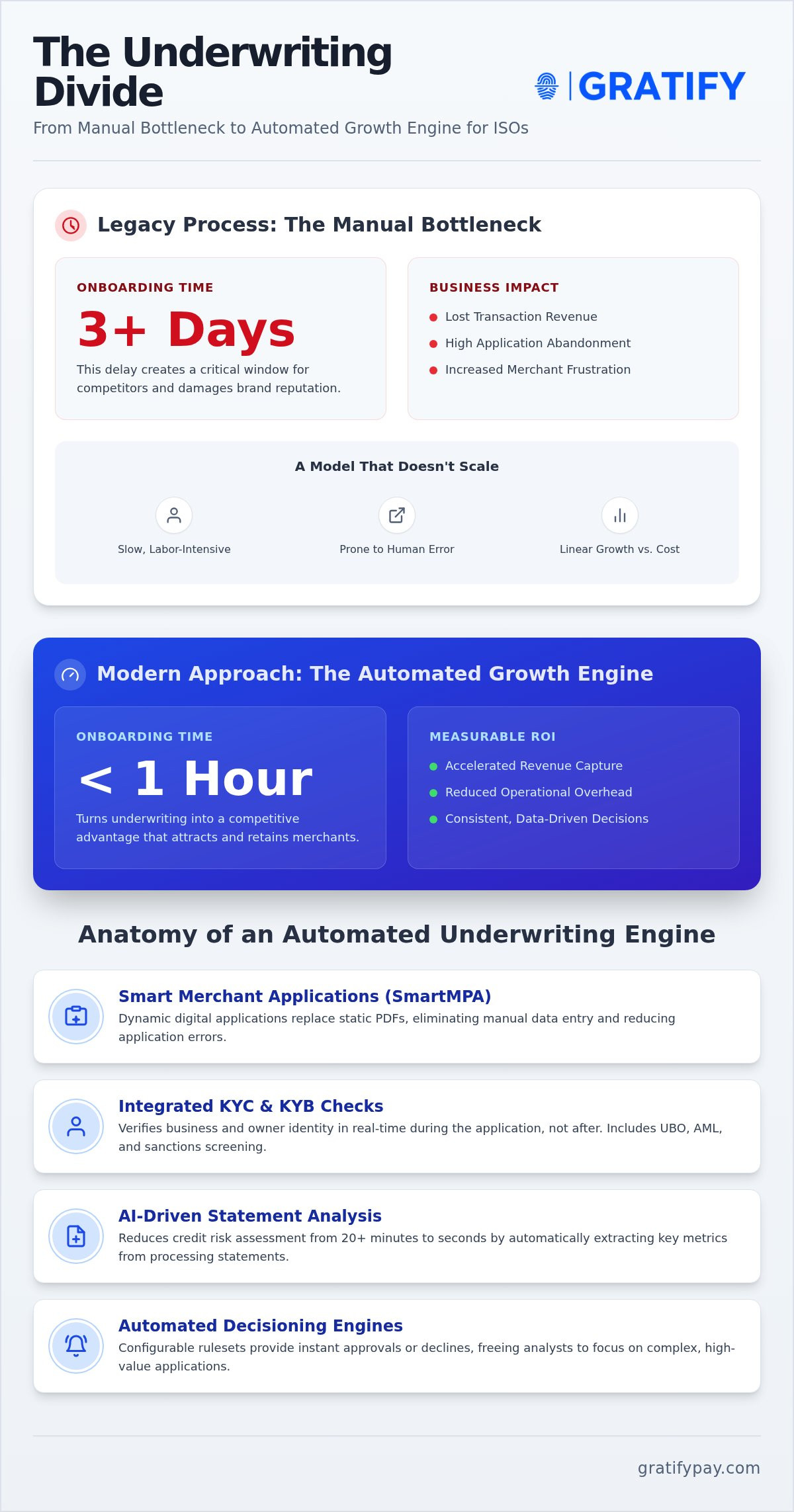
The Manual Underwriting Bottleneck: Why ISOs Are Falling Behind
Manual underwriting is a direct constraint on an ISO's ability to grow its merchant portfolio. The process is inherently slow, prone to human error, and does not scale efficiently. As application volume increases, an ISO must hire more risk analysts, leading to a linear relationship between growth and overhead. This model is unsustainable in a market that demands speed and efficiency.
The hidden costs extend beyond payroll. Slow onboarding contributes directly to 'application abandonment,' where merchants seek faster alternatives. Legacy underwriting systems, often operating in silos, create technical debt that makes it difficult to adapt to new risks or compliance standards. For ISOs aiming to scale in 2026, relying on a linear hiring strategy for the risk department is no longer a viable option.
The True Cost of a 3-Day Onboarding Window
A multi-day waiting period between a merchant's application and final approval creates significant business risks. During this time, potential revenue is lost, and merchants grow frustrated. This delay provides a window for competitors to engage the same merchant with a faster, more modern onboarding experience. The negative impression can damage the ISO's brand reputation and increases the likelihood of merchants submitting applications to multiple processors simultaneously.
Lost Revenue
Every day an approved merchant is not processing represents a direct loss of transaction revenue for the ISO.
Merchant Frustration
Lengthy and opaque review processes create a poor first impression, increasing churn risk before the relationship even begins.
Competitive Disadvantage
PayTech competitors using automation can approve and board merchants in under an hour, making a multi-day process non-competitive.
Legacy vs. Modern Underwriting Paradigms
The traditional approach to underwriting treats compliance as a checklist. It is a reactive, manual process focused on historical data. A modern, automated approach redefines underwriting as a structural growth engine. It uses real-time data ingestion and dynamic risk scoring to make faster, more consistent decisions.
This shift is critical in a volatile market. Automated systems can analyze data points and identify risks far more quickly and consistently than human analysts. This allows ISOs to adapt to changing economic conditions and regulatory requirements without disrupting the speed of merchant acquisition. The modern paradigm moves underwriting from a cost center to a core component of a scalable growth strategy.
The Anatomy of an Automated Underwriting Engine for ISOs
An effective automated underwriting engine is not a single tool but an integrated system designed to eliminate manual tasks and accelerate decisions. It combines identity verification, data collection, statement analysis, and decisioning logic into a single, efficient workflow. This system acts as the central nervous system for an ISO's risk management and merchant onboarding operations.
Integrated KYC and KYB
Automation moves beyond basic identity checks to perform comprehensive business verification in real time.
Smart Merchant Applications (SmartMPA)
Dynamic digital applications replace static PDFs, eliminating manual data entry and reducing errors.
Digital Statement Analysis
AI-powered tools extract and analyze credit risk indicators from merchant processing statements in seconds.
Automated Decisioning Engines
Configurable rulesets enable instant approvals or declines for clear-cut cases, freeing up analysts to focus on complex applications.
KYB and Identity Verification in One Flow
Modern platforms integrate KYB and KYC verification directly into the application process. As a merchant completes a digital application, the system works in the background to verify the business and its owners against multiple data sources. This includes automating Ultimate Beneficial Owner (UBO) identification, screening against sanctions and Anti-Money Laundering (AML) watchlists, and cross-referencing public records. By pre-populating business data and running checks in real time, this integrated flow dramatically reduces friction for the applicant and condenses a multi-day manual process into minutes.
AI-Driven Statement Analysis Explained
Manually reviewing and "spreading" merchant processing statements is a time-consuming task for underwriters. AI-driven statement analysis automates this entirely. The technology uses sophisticated data extraction models to read PDF statements from any processor, instantly identifying key metrics like processing volume, average ticket size, chargeback ratios, and fee structures. It can also detect seasonal trends and risk anomalies that might be missed in a manual review. Digital statement analysis eliminates the need for spreadsheets and reduces the time required for credit risk assessment from over 20 minutes to just a few seconds.
Speed vs. Risk: Calculating the ROI of Automation
The business case for automated underwriting is built on measurable improvements in speed, cost, and risk management. By replacing manual tasks with intelligent automation, ISOs can process more applications with greater accuracy and less overhead. This creates a significant competitive advantage, allowing an ISO to capture revenue faster while maintaining strong risk controls. The "instant approval" experience also has a powerful impact on reducing portfolio churn.
A common objection is whether an AI can outperform a human analyst in identifying subtle risks. Modern systems are designed with human-in-the-loop workflows, flagging complex or high-risk applications for expert review. This hybrid approach combines the speed and consistency of automation with the nuanced judgment of an experienced underwriter, leading to better overall risk accuracy. It also enables a single analyst to manage up to 10x the volume of applications compared to a fully manual process.
The ROI Framework for ISO Operations
To calculate the return on investment, ISOs should compare the costs and outcomes of their current manual process against an automated model. The framework should account for labor savings, the revenue impact of faster onboarding, and the financial benefit of more accurate risk decisions.
| Metric | Manual Underwriting Process | Automated Underwriting Process |
|---|---|---|
| Cost Per Application | Up to $496 (Traditional Bank) | ~$214 (PayTech/Modern PSP) |
| Onboarding Time | 1 to 7 days | Under 60 minutes |
| Analyst Time Per Application | Hours | Minutes (for exceptions only) |
| Application Pend Rate | 10-15% (due to missing info) | Significantly reduced |
| Merchant Drop-Off Rate | 30-35% (due to delays) | Minimized with instant decisions |
Key calculations include the total labor cost saved in the risk department, the "Speed-to-Revenue" lift from same-day merchant boarding, and the reduction in losses from "False Declines," where perfectly good merchants are rejected due to overly cautious or inconsistent manual reviews.
Risk Mitigation in the Automated Era
Automation enhances risk mitigation by standardizing the decision-making process. By using a centralized, configurable rules engine, an ISO ensures that every application is evaluated against the same criteria. This consistency is crucial for regulatory compliance and for maintaining strong relationships with sponsor banks. Automated systems provide clear, auditable records of every decision.
Real-time data checks during the onboarding process can detect fraud indicators that might be missed in a manual review. This includes verifying business registration, checking for sanctions, and identifying connections to high-risk individuals or entities. Automated due diligence provides a robust, documented, and repeatable process that satisfies sponsor bank oversight requirements.
Implementation Strategy: Transitioning Your ISO to Automation
Transitioning from a manual to an automated underwriting system requires a structured approach. The goal is to minimize disruption while maximizing the benefits of the new technology. A successful implementation focuses on a phased rollout, clear workflow mapping, and retraining the risk team to oversee the automated system.
Audit current friction points
Identify the biggest bottlenecks in your existing onboarding process.
Plan a phased rollout
Begin with low-risk merchant categories to build confidence and refine the process.
Choose the right integration
Decide between using API integrations for a custom experience or a white-label portal for faster deployment.
Train your risk team
Shift the role of underwriters from manual data processors to 'exception managers' who handle complex cases escalated by the system.
Mapping Your New Onboarding Workflow
The first step is to replace static PDF applications with dynamic Smart Merchant Applications. Next, configure the decisioning engine to set clear thresholds for "Auto-Approval" and "Auto-Decline" based on your ISO's risk appetite and sponsor bank requirements. Finally, define the specific triggers that will escalate an application for manual review. This ensures that your risk analysts focus their time and expertise where it is most needed, rather than on routine applications that the system can handle instantly.
Ensuring Compliance During the Transition
A key requirement during the transition is maintaining a complete audit trail for every decision. Modern platforms automatically log every action, data point, and rule that contributed to an approval or decline, simplifying sponsor bank reviews. Internal Standard Operating Procedures (SOPs) must be updated to reflect the new automated risk scoring and escalation protocols. It is also important to remember that underwriting does not end at boarding. Continuous portfolio monitoring, another capability of advanced platforms, is essential for managing risk throughout the merchant lifecycle.
Scaling Your ISO Portfolio with Gratify
Gratify provides an AI-powered platform designed specifically to automate the full merchant lifecycle for ISOs. The system streamlines everything from the initial application to final approval, enabling ISOs to board more merchants faster and more efficiently. By using advanced statement analysis and real-time verification, Gratify helps ISOs win larger, more complex merchants that are often difficult to underwrite manually.
This efficiency directly reduces merchant acquisition costs (CAC) and shortens the time-to-revenue. By adopting Gratify's technology, an ISO can position itself as a modern, tech-forward leader capable of delivering the fast, frictionless onboarding experience that merchants expect in 2026.
Built for ISOs and PayFacs
The Gratify platform is built with the specific needs of ISOs and Payment Facilitators in mind. It offers customizable risk parameters that can be tailored to match your unique risk appetite and sponsor bank requirements. White-label capabilities provide a consistent brand experience for your merchants throughout the application process. The platform's scalable infrastructure is designed to grow with your portfolio, ensuring you can handle increasing application volume without a corresponding increase in headcount.
The Gratify Advantage: Beyond Underwriting
Gratify offers integrated lifecycle management, from a merchant's first click to their first payout. The platform also empowers sales teams with instant pre-qualification tools, allowing them to focus their efforts on viable merchants. By automating the most time-consuming aspects of risk and compliance, Gratify frees up your team to focus on strategic growth initiatives.
Schedule a demo with Gratify to see automated underwriting in action.
Frequently Asked Questions
What is automated underwriting for ISOs?
Automated underwriting for ISOs is the use of software to automate the risk assessment and decision-making process for new merchant applications. It replaces manual tasks like data entry, document verification, and credit checks with an integrated system that provides instant or near-instant approvals.
How does automated KYB reduce merchant onboarding time?
Automated Know Your Business (KYB) reduces onboarding time by verifying a merchant's business identity in real time during the application process. It instantly checks business registration data, identifies beneficial owners, and screens against government watchlists, condensing a process that once took days into a few minutes.
Can automated underwriting software detect fraud as well as humans?
Yes. Automated systems can often detect fraud more consistently than humans by cross-referencing thousands of data points in real time. They excel at identifying patterns and anomalies that may not be apparent in a manual review. For complex cases, they are designed to escalate to human experts, combining the best of machine speed and human intuition.
Is automated statement analysis secure for sensitive merchant data?
Yes. Reputable platforms use robust security protocols, including data encryption at rest and in transit, to protect sensitive merchant information. These systems are designed to meet or exceed financial industry security standards to ensure data confidentiality and integrity.
Calculate your onboarding costs
ISOs processing 1,000 merchants/year spend $250K on manual onboarding. See your numbers.
Get Your Cost Analysis